Dog Reactivity and Photoshoots: What You Need to Know
Your Dog Does Not Need to Become a Different Dog for Photos
If you have a reactive dog, you've probably gotten very good at thinking three steps ahead.
You notice the dog coming around the corner before anyone else does. You know which neighborhood route gives you the most escape options. You have crossed streets, ducked behind parked cars, turned completely around, and probably developed a sixth sense for the sound of a jingling collar somewhere in the distance.
I know because I've lived it.
My dog, Leila, has been dog reactive for most of her life. She was my first dog, and when I brought her home as a teenager, I had a very different idea of what life with a dog was going to look like.
Then came the barking. The lunging. The overwhelming walks. The research rabbit holes. The training sessions. The days when something went beautifully, followed by a day that made me wonder whether we had made any progress at all.
It changed the way I understood dogs.
Eventually, it also changed the way I photographed them.
So when someone tells me before a session, "Just so you know, my dog is reactive," my immediate thought isn't that this is going to be difficult.
My thought is: Okay. Tell me about your dog.
Because reactivity doesn't disqualify them from being photographed.
It just gives me information about how we should build their session.
Reactive Dogs Aren't One-Size-Fits-All
"Reactive" can mean very different things from one dog to another.
Maybe your dog loses their mind when another dog comes too close but couldn't care less about people.
Maybe bicycles are the problem.
Maybe it's men, children, skateboards, runners, squirrels, unfamiliar dogs, loud noises, or a very specific combination of circumstances that you have unfortunately become extremely good at recognizing.
Some dogs need a huge amount of distance from a trigger. Others can notice something across a field, check back in with their person, and continue on.
This is why I don't hear "reactive" and automatically apply one generic session plan.
I want to know your dog.
When you're booking with me, telling me your dog is reactive isn't something you need to apologize for or casually tuck into the last sentence of your questionnaire.
Give me the information.
What are their known triggers?
How much distance usually feels comfortable?
What does it look like when they're starting to become overwhelmed?
Are there environments you already know are a hard no?
What helps them recover?
Is there equipment you use to keep them safe and comfortable?
You know your dog in a way I never could after meeting them for five minutes. That knowledge is incredibly valuable to me.
I don't want to work around you as if I'm the expert on your individual dog.
I want us to work together.
I'm a Photographer, Not Your Dog's Trainer
This distinction is important to me.
I have years of firsthand experience living with a reactive dog, working with dogs in front of my camera, and learning to recognize when a session needs to change course.
But I'm not a dog trainer or veterinary behaviorist, and your photography session isn't the place where I'm going to attempt to fix your dog's behavior.
I'm also not going to ask you to abandon management strategies that already work for your dog because they aren't aesthetically convenient for me.
If your dog wears a harness, we work with the harness.
If they need their leash, their leash stays on.
If your dog comfortably wears a muzzle as part of their normal management, I have absolutely no problem photographing them wearing it.
Safety equipment is not something your dog needs to graduate from before they are worthy of beautiful pictures.
My job is to understand what helps your dog move through the world successfully and photograph within those boundaries.
Choosing a Location Is About More Than Finding Somewhere Empty
The prettiest location in Houston isn't automatically the best location for your dog. For reactive dogs, I care much more about how a space functions. For example:
Can we see what's approaching?
Do we have somewhere to move if another dog appears?
Are we trapped on one narrow trail, or can we change direction?
Is there enough room to work without constantly asking your dog to exist right at the edge of what they can tolerate?
And even then, "quiet" does not mean "guaranteed empty."
That's an important distinction.
When we're photographing in a public space, I can make informed recommendations about locations and times that tend to have lower traffic. I can intentionally avoid a busy Saturday afternoon at one of Houston's most popular parks.
What I can't honestly promise you is that another dog will never appear.
Instead, I want a location that gives us options when real life happens.
Maybe we step farther off the trail, or we turn around.
Maybe we spend a few minutes somewhere else while another dog passes.
Maybe we abandon one shooting area entirely because the environment has changed.
That's not the session falling apart.
That's us responding to the dog standing in front of us instead of stubbornly following a plan we made three weeks ago.
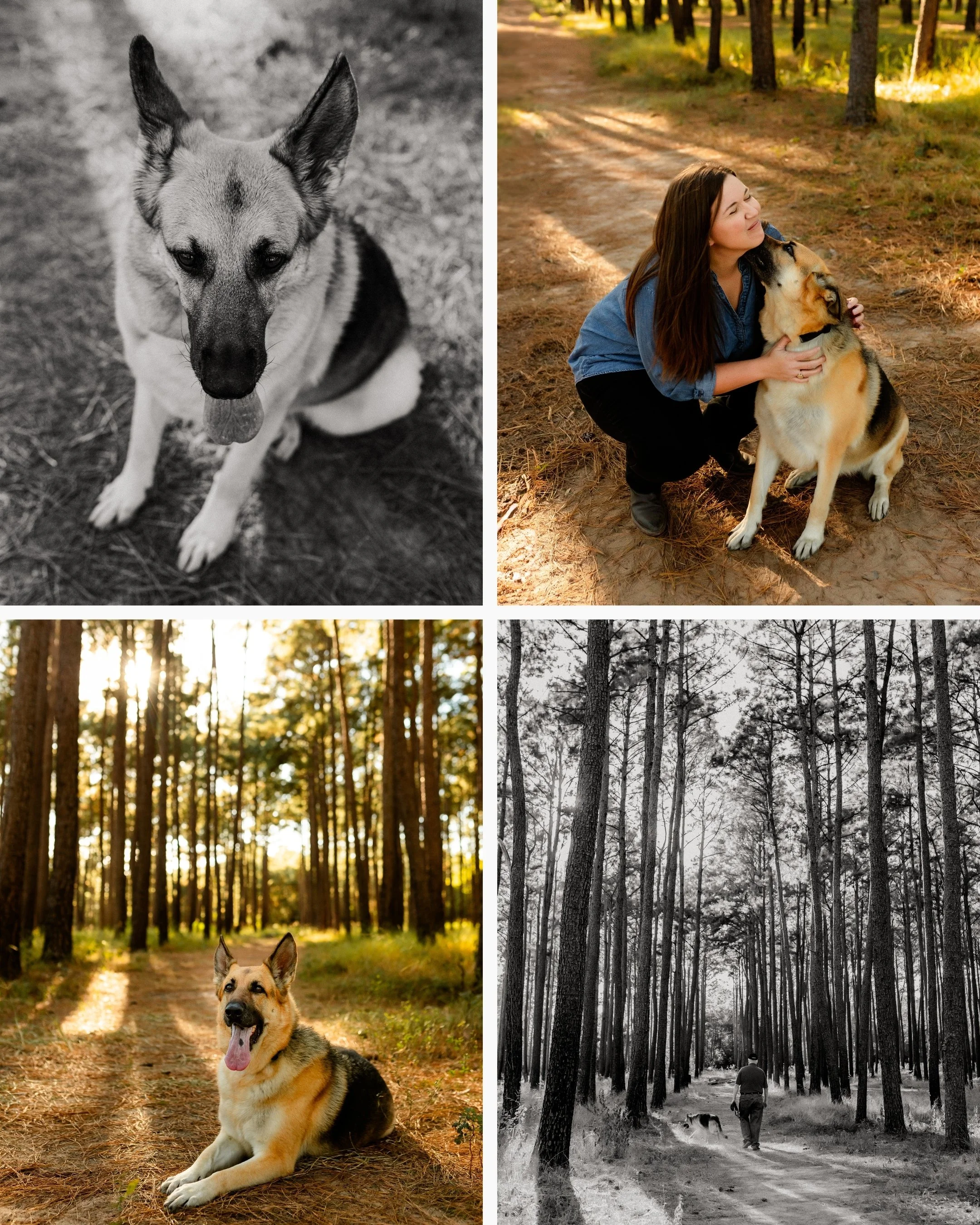
What Happens If My Dog Reacts During the Photoshoot?
They react. And then we adjust. That’s it.
A bark doesn't ruin your session.
A lunge doesn't mean I'm secretly thinking your dog is terrible.
Needing more distance doesn't mean we failed.
Living with Leila has given me intimate knowledge of that awful feeling when your dog has a big reaction in public, and suddenly it feels like every person within a five-mile radius is staring at you.
You don't need that feeling from your photographer, too.
If your dog reacts, I'm far more interested in what we do next.
Maybe that means creating more distance. Maybe you need a moment together. Maybe we walk somewhere quieter before doing anything else.
And while you're handling your dog, you do not need to worry about performing for my camera.
I am not standing there thinking about the shot we're missing.
There will be another shot.
Your dog feeling safe enough to continue matters more.
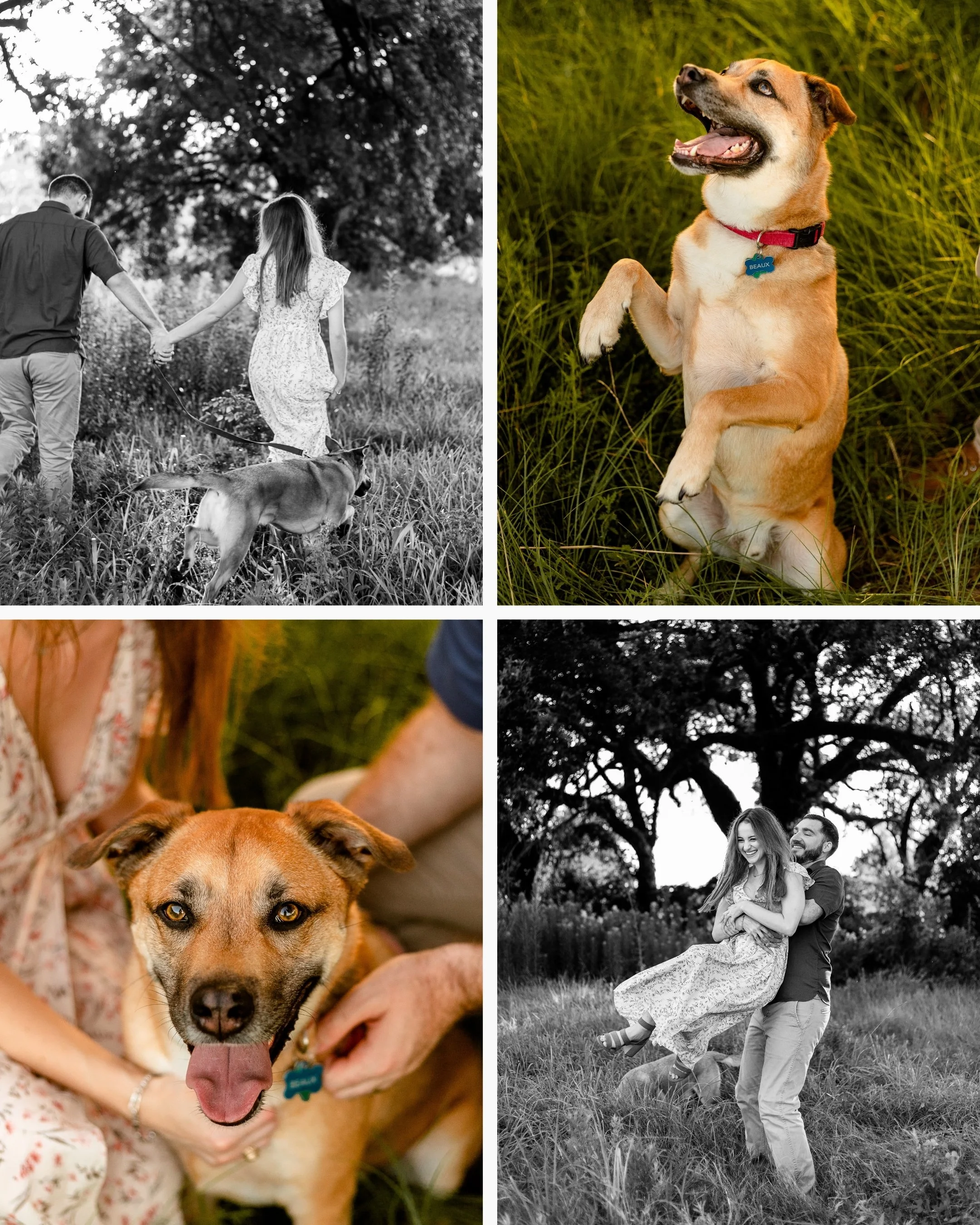
I Pay Attention Before We Ever Reach the Big Reaction
One of the things life with a reactive dog has taught me is how much can happen before barking or lunging ever enters the picture.
You start learning your own dog's tells: the way their body changes, the scanning, the fixation – the inability to disengage from something.
The moment when you realize they aren't really participating with you anymore because all of their attention has shifted to the environment.
Dogs communicate discomfort in many ways, and some signals are much subtler than growling or barking. That's one reason I would rather respond when a dog is beginning to struggle than keep pushing until they have to make their discomfort incredibly obvious.
During your session, I'm watching too.
That doesn't mean I know your dog's body language better than you do. You are always welcome to tell me, "She needs a minute," before I've noticed anything at all.
In fact, please do.
You never need permission from me to advocate for your dog.
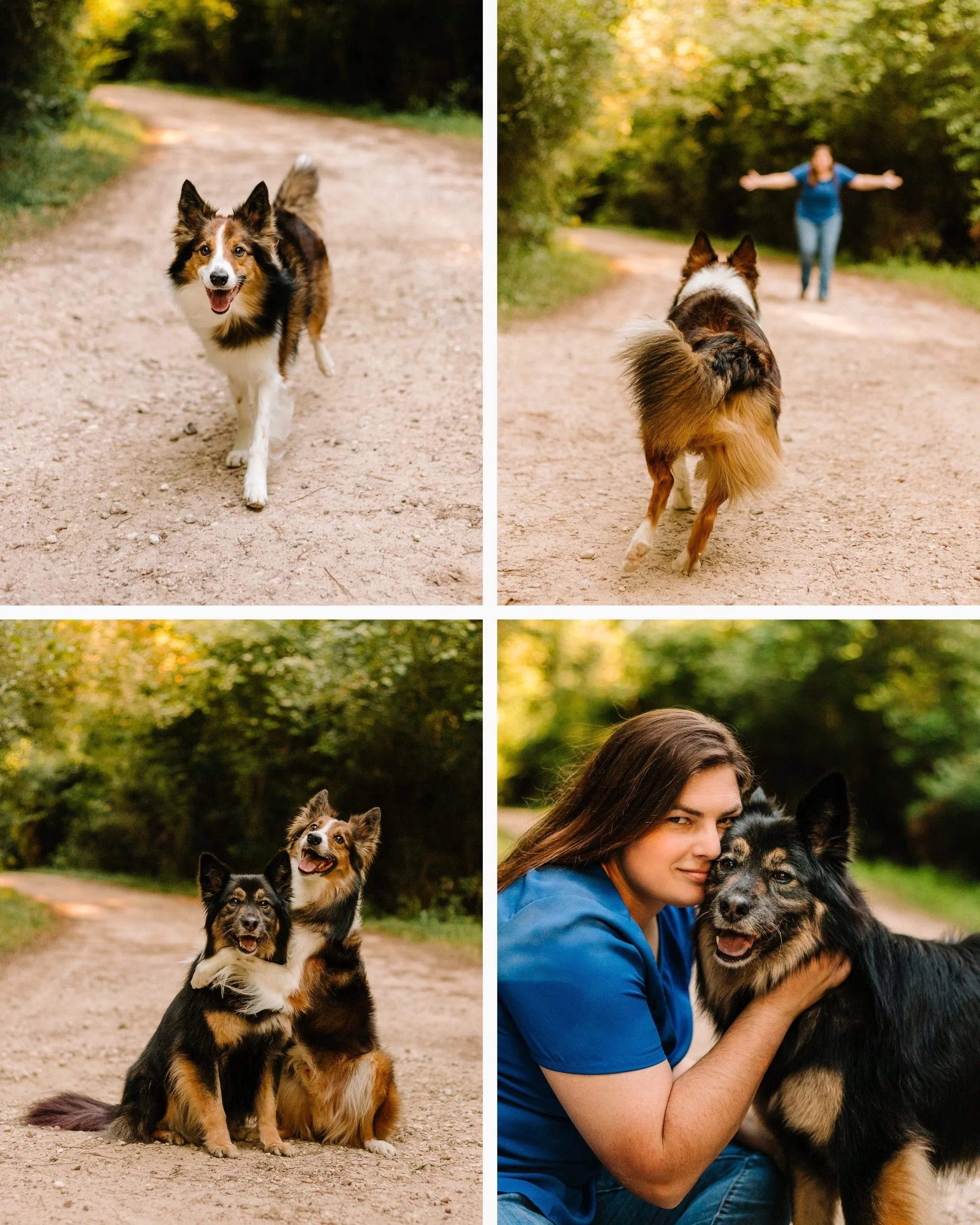
Your Dog Doesn't Have to Spend the Entire Session Looking Relaxed
This is another expectation I think reactive-dog parents put on themselves without realizing it.
You might imagine professional photos requiring your dog to completely forget that the rest of the world exists.
That isn't realistic for every dog.
Some dogs are going to look around; they're going to sniff, check what's happening behind us, and they may need a minute before they can settle into another activity.
That's okay.
I'm not measuring the success of your session by how long your dog can hold eye contact with my camera.
Some of my favorite photographs happen in between all of that anyway.
You rubbing their chest while they watch something in the distance.
Their nose buried in the grass.
The way they automatically lean back against your legs.
That familiar look they give you.
The interaction after the thing that briefly caught their attention has passed.
We're photographing your relationship with your dog, not putting them through an obedience course.
Management Is Not Cheating
This deserves its own section because I wish more reactive-dog parents heard it.
You are allowed to manage the environment.
We can use distance, choose quieter hours, change paths, keep the leash on, use treats. Most importantly, we can let your dog decompress.
We can decide not to attempt something that seemed like a good idea on paper.
There is no prize at the end of your session for making things unnecessarily difficult.
Good photographs do not require us to prove how much your dog can tolerate.
If anything, thoughtful management often gives me more opportunities to photograph the version of your dog you actually recognize.
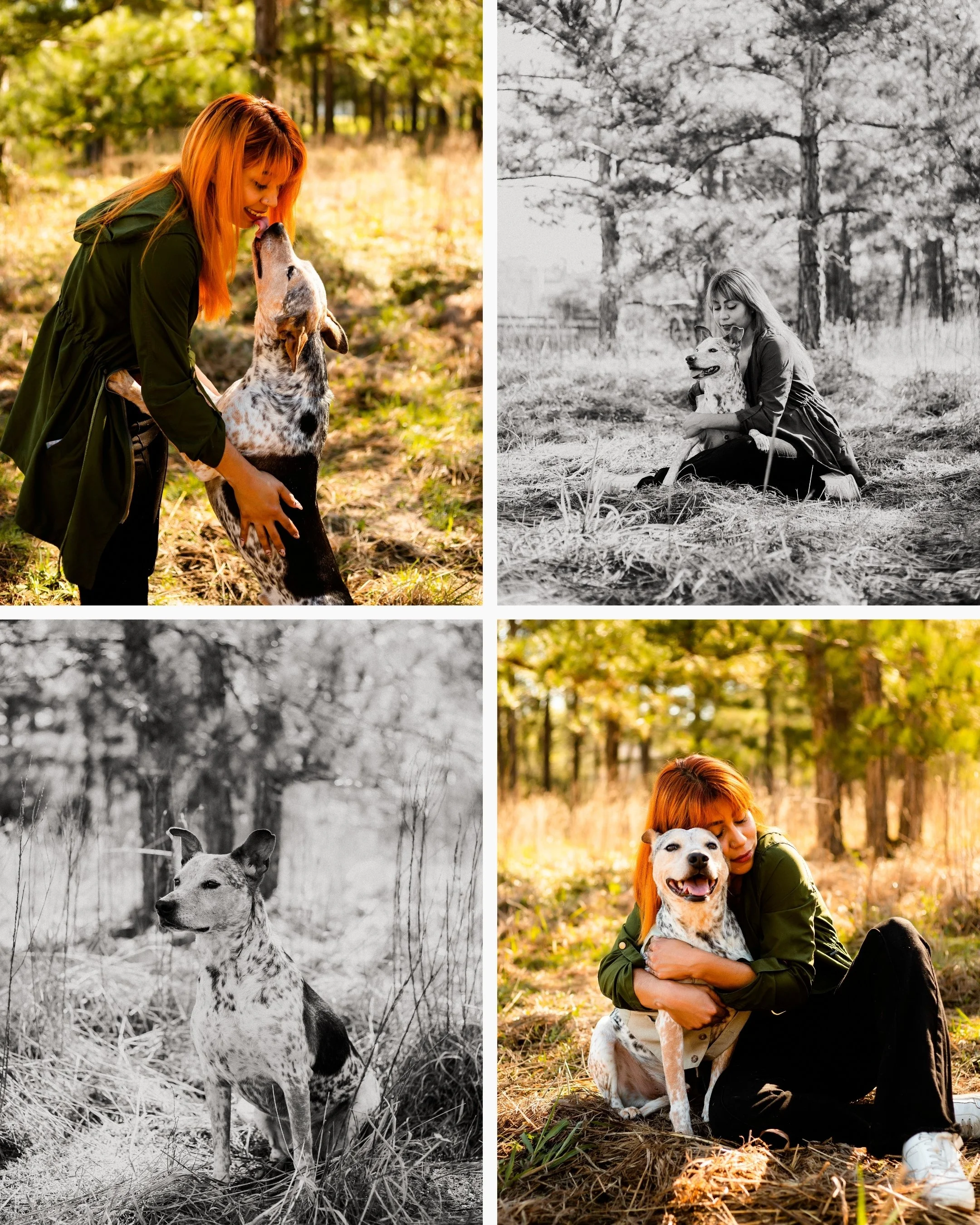
What About the Leash?
For most dogs I photograph, reactive or otherwise, the leash stays on.
It does not prevent us from making beautiful images.
I work with leash placement, your positioning, movement, and composition while I'm shooting. There may occasionally be an image where leash removal makes sense during editing, particularly for a portrait, but I do not build sessions around pretending your dog was off-leash when they weren't.
And I definitely won't ask you to physically remove a leash when doing so would compromise your dog's safety.
The goal isn't to manufacture the appearance of a perfectly behaved off-leash dog.
The goal is to make photographs you love of your actual dog.
What If an Outdoor Location Still Feels Like Too Much?
Then we don't have to use one.
An outdoor location is not the only place a meaningful dog photography session can happen.
Depending on your dog and the kind of session you want, your own home or backyard can sometimes be a much better fit.
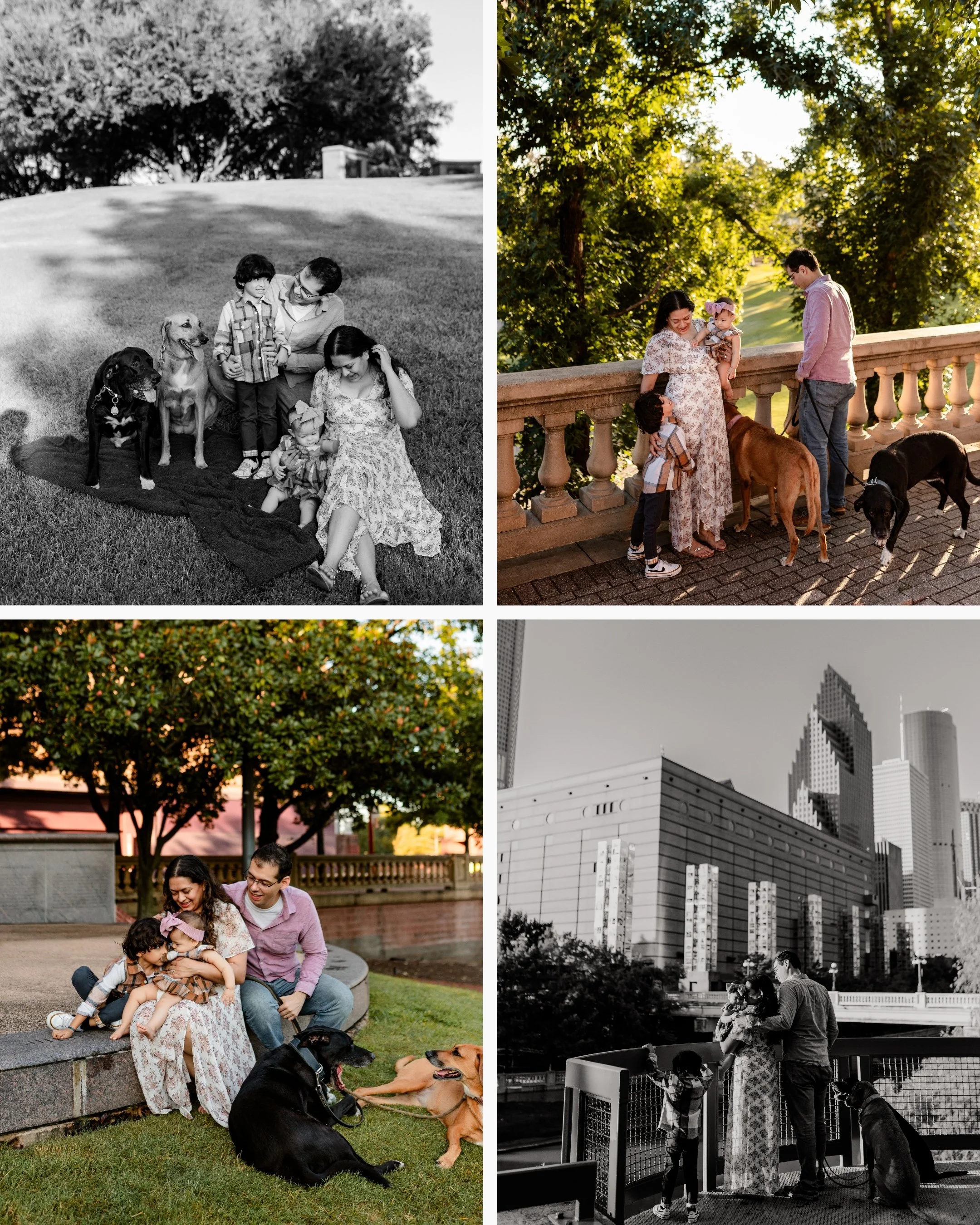
There is something especially lovely about photographing a dog in the place where they already know every smell, favorite patch of sunlight, window, couch, and backyard corner.
For some dogs, removing the environmental uncertainty of a public location gives us an entirely different experience.
I talk through this with my clients when we’re in the planning stages.
I would much rather choose a location that genuinely works for your dog than select somewhere impressive because it photographs well on Instagram.
What I Want You to Tell Me Before Your Session
You cannot scare me away by giving me "too much information" about your dog.
Quite the opposite! I’m here for the weirdly specific stuff. (Seriously.)
Does your dog hate Huskies specifically?
Are bikes fine unless the rider has a helmet?
Are they usually great until another dog stares at them?
Do they take longer to settle somewhere new?
Are they terrified of men but obsessed with women?
This isn't information I'm going to use to judge your dog. It genuinely helps me photograph them better.
And if something is outside what I can safely accommodate, I will be straightforward with you about that too. Part of working responsibly with dogs means being willing to have those conversations instead of promising that absolutely anything will be fine.
I've Been on the Other Side of the Camera Too
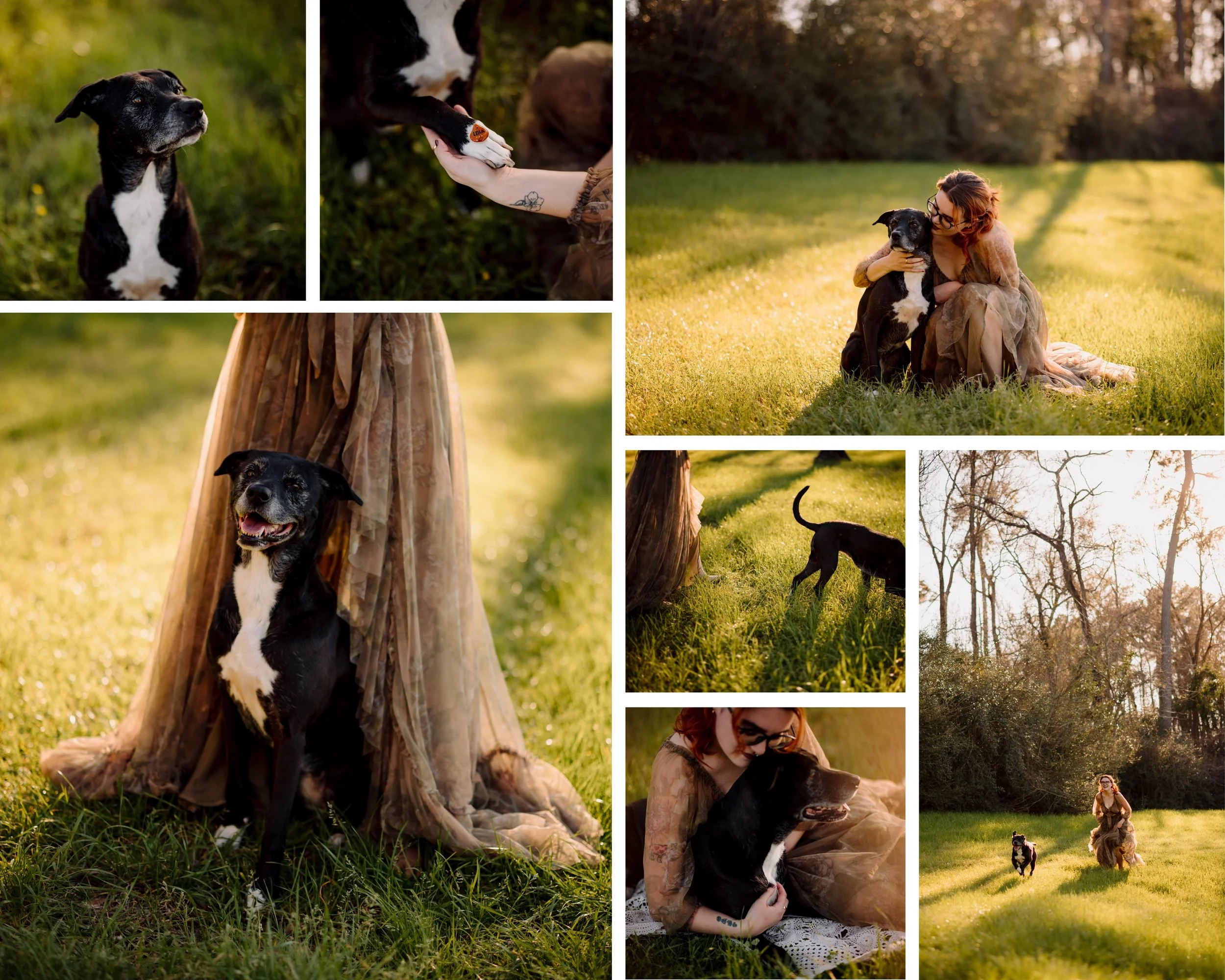
Some of my most treasured photographs of Leila and me were taken by Ashley Newman Photography.
And one of the reasons that experience stayed with me had very little to do with Leila performing beautifully for the camera.
Ashley listened.
She understood that Leila had specific needs. We chose somewhere secluded, away from the things most likely to make the experience difficult for her. There was room to explore instead of constantly managing what was approaching us.
I didn't spend the entire photoshoot holding my breath and scanning the horizon.
That mattered.
Because when I wasn't worrying about whether Leila was going to have a reaction, I got to actually be with her.
I got to play with her.
Look at her.
Love on her.
And now I have photographs of a dog who has shaped an enormous part of my life.
That experience is something I carry into my own work.
I know what it means to have a dog who changes the way you navigate the world.
I also know that their complicated relationship with that world does not make your relationship with them any less worthy of documenting.
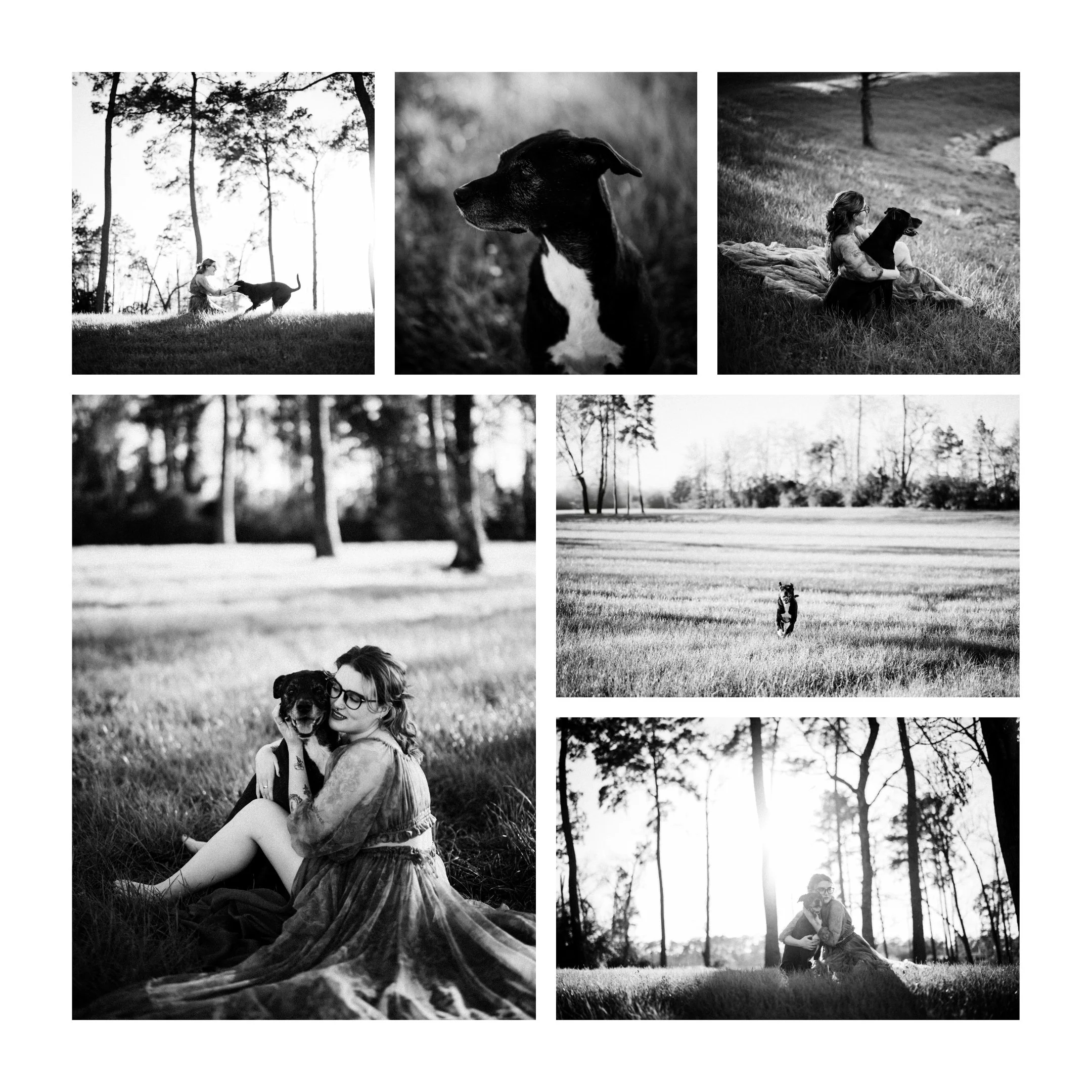
Photos of me and Leila by Ashley Newman Photography
Your Reactive Dog Is Still Your Dog
They're still the dog who follows you into the kitchen.
The dog whose ears you know by silhouette.
The dog with a favorite sleeping position, ridiculous habit, particular way of asking for something, or look that only you understand.
Reactivity is something you manage.
It isn't the entirety of who they are.
And it certainly doesn't have to be the reason you don't have photographs together.
If you've spent years planning your walks around other dogs, explaining your dog's boundaries to strangers, or wondering whether a photographer would really understand, I want you to know that you do not need to downplay any of it with me.
Tell me what your dog needs and we'll build the session from there.
Looking for a Reactive-Dog-Friendly Photographer in Houston?
I photograph dogs and their people throughout Houston, Spring, The Woodlands, Conroe, and the surrounding areas, with sessions built around the individual dog rather than expecting every dog to fit the same process.
If you're unsure whether a photoshoot could work for your dog, you don't need to figure that out alone before reaching out.
Tell me about them! Tell me what you're worried about.
I'm happy to talk through what a session could realistically look like and help you decide whether it's the right fit.